 Comfie
Cold morning, warm afternoon: how to dress for a 25 degree swing
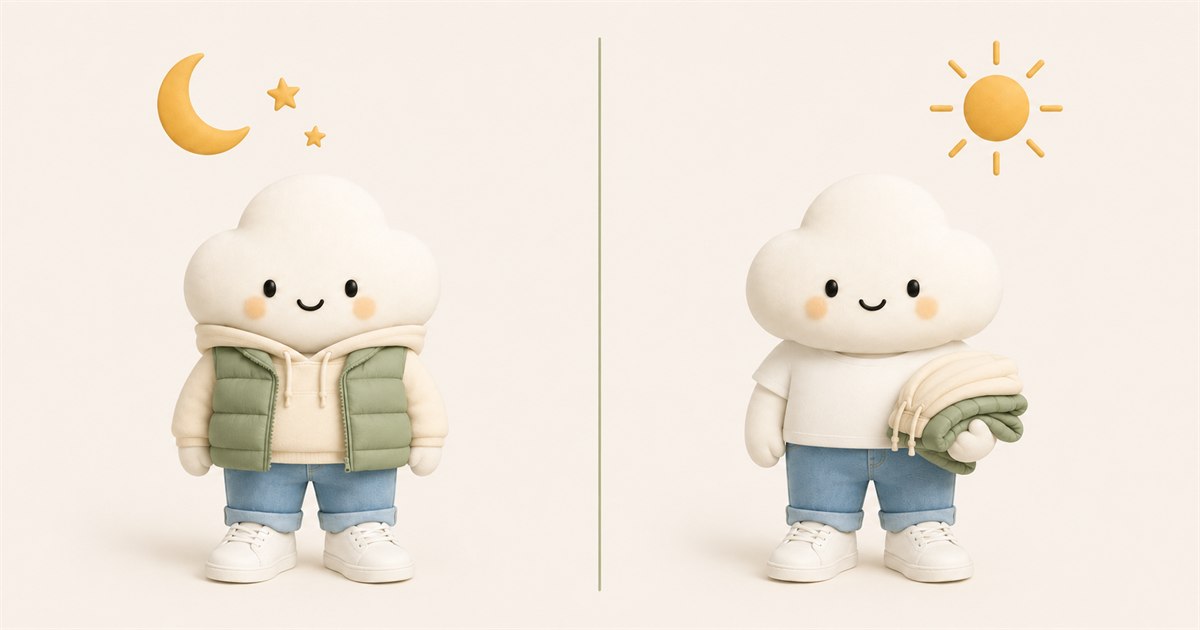
Pick your base layer, your trousers and your shoes for the afternoon high. Pick everything you can take off for the morning low. A 25°F swing (14°C) needs two removable pieces rather than one: a hoodie or fleece for most of it, and a vest or light jacket for the rest.
That's the whole answer, and you can stop reading. The rest of this is why it's two pieces and not one, why the same 25 degree swing is four times more annoying in March than in May, and the point at which the problem quietly stops being about your top half at all.
The rule most people half-remember
In hoodie and jeans weather we put it as top for the low, bottom for the high. Six words, easy to keep in your head, and right about the thing most people get wrong.
It's also incomplete, and the gap shows up exactly when the swing gets big.
Here's what it misses. That rule names two things you're choosing. There are three. Your trousers are locked in when you leave the house, yes. So are your shoes. And so is the shirt at the bottom of the stack, because taking off your outer layers in public is fine and taking off your base layer is a different kind of afternoon.
So the full version goes: everything you can't take off gets picked for the high. Everything you can take off gets picked for the low. Three locked, the rest flexible.
This sounds like a small correction. It isn't. On a 45°F to 70°F day (7 to 21°C) our engine wants a long sleeve at breakfast and a t-shirt at lunch. Wear the long sleeve, which feels obviously correct at 7am, and you're stuck one warmth point too hot for the entire afternoon with no way to fix it. Wear the t-shirt and you're one point light for about an hour, which the hoodie you're already wearing covers completely.
One of those mistakes lasts an hour. The other lasts eight.
Three things you can't take off at 2pm
Two of the three have a hard number attached, and they're worth knowing because they're the decisions with no undo.
- Your shoes flip at 42°F (6°C). Below that Comfie puts you in boots, above it sneakers. A morning that starts at 38°F and climbs to 63°F is the trap: boots are right for the first two hours and mildly wrong for the next ten.
- Your trousers flip at 75°F (24°C), then again at 80°F (27°C). Jeans hold up across a huge stretch of the year, then hand off to lighter pants, then to shorts. Those two thresholds are where a swing stops being solvable from the waist up.
- Your base layer has no threshold, which is the point. Nothing forces the decision, so people default to whatever suits the moment they're standing in. That moment is the coldest one of the day.
Why one jacket is never enough for a 25 degree swing
Most layering advice treats layers as interchangeable units. Add a layer, get warmer. One competitor's guide puts a number on it and says each layer is worth roughly 8°F.
Layers aren't worth the same amount, and the difference is the entire decision.
Comfie's engine runs on warmth points. A t-shirt is 2, a hoodie is 3, a light jacket is 2, a puffer is 4, a parka is 5. Each band of temperature has a target, and the engine stacks items until it hits it. Boring, and it means every claim on this site is a subtraction rather than an opinion.
The useful part is the exchange rate between points and degrees, which isn't constant. Around 45°F one warmth point buys you 4°F. Up at 65°F it buys 6°F. Convert the catalog and you get this:
- Windbreaker (1 point): about 4 to 5°F, or 2 to 3°C
- Light jacket or puffer vest (2 points): about 8 to 10°F, or 4 to 6°C
- Hoodie, fleece or sweater (3 points): about 12 to 15°F, or 7 to 8°C
- Puffer jacket (4 points): about 16 to 20°F, or 9 to 11°C
Now look at the number in the title. Twenty-five degrees. There is nothing on that list that covers it. The hoodie gets you to fifteen at best and the puffer overshoots into gear you'd hate at noon.
So the answer to "which one item does the most work" is that no item does. You need a 3 point mid layer and a 2 point outer, which together buy you 20 to 25°F and, more importantly, let you take the swing off in two stages. One jacket is one decision, and you get to make it once, at the wrong time of day.
Picking between a vest, a light jacket and something heavier is a separate question with its own thresholds, and do I need a jacket today works through where each one stops being enough.
Why two stages beats one: a day doesn't go from 45 to 70 at a stroke. It creeps. With a hoodie and a vest you shed 2 points at 10am and 3 more at noon, and you're roughly right the whole way. With one 5 point coat you're too warm from 10 until you give up and are then too cold. Same total warmth, twice the discomfort.
Rather not do this arithmetic at 7am? The live demo runs it from your city name, no download.
The same swing costs four times more at the cold end
This is the part that surprised us when we ran the bands, and we wrote the bands.
A 25 degree swing is not one thing. Where it sits on the scale changes what it costs you, and the spread is much wider than the identical gap suggests. Below, each row is a 25°F (14°C) swing. The only difference is the height.
| Morning to afternoon | Warmth to shed | What that means at 2pm |
|---|---|---|
| 25 to 50°F-4 to 10°C | 12 points | Six things in your arms: sweater, parka, beanie, gloves, scarf, wool socks. |
| 30 to 55°F-1 to 13°C | 9 points | Fleece, puffer jacket, beanie, gloves. A bag stops being optional. |
| 35 to 60°F2 to 16°C | 7 points | Fleece, puffer jacket, beanie. |
| 40 to 65°F4 to 18°C | 5 points | Hoodie and puffer vest, plus boots you stopped needing at 9am. |
| 45 to 70°F7 to 21°C | 6 points | Hoodie and puffer vest. Nothing locked changes. This is the easy version. |
| 50 to 75°F10 to 24°C | 4 points | A fleece. But your jeans wanted to be lighter pants. |
| 55 to 80°F13 to 27°C | 3 points | A hoodie. The jeans are now the problem, not the top. |
| 60 to 85°F16 to 29°C | 4 points | A hoodie, and both your trousers and your shoes are wrong. |
Swipe the table sideways for the rest of each row.
Twelve points at the cold end. Three at the warm end. Identical swing.
The reason is that warmth points and degrees don't trade evenly across the range. Down at 30°F you need a lot of insulation to move the needle a little, so climbing out of the cold means dismantling a whole stack. Up at 55°F you're already close to wearing nothing much, and there's simply less to take off.
Which gives you a genuinely useful planning rule: the forecast gap tells you half the story, and the morning low tells you the other half. A 25 degree swing starting at 25°F is a six item day. The same swing starting at 55°F is a one item day. If you only ever remember one thing from this article, make it that, because it's the bit that decides whether you need a bag.
Note the row that isn't monotonic. The 40 to 65 day sheds 5 points and the 45 to 70 day sheds 6, even though it's the warmer day. That's a band edge doing it: 70°F lands in t-shirt territory while 65°F still wants a long sleeve. Real thresholds have steps in them, and pretending otherwise is how you end up with advice that's smooth and wrong.
What to wear for a 45°F morning and a 70°F afternoon
The most common version of this day, and the one worth working through properly.
At 45°F (7°C) the engine asks for 8 warmth points up top and picks a long sleeve, a hoodie and a puffer vest. At 70°F (21°C) it asks for 2 and picks a t-shirt. Bottom half is jeans at both ends. Shoes are sneakers at both ends, because 45 clears the 42°F boot line.
So both locked items agree, which is why this is the friendly version of a 25 degree swing. Only the base layer is in tension, and the rule settles it. Wear the t-shirt.
- T-shirt. The afternoon's choice, worn from the start. You're one point light at 7am and it doesn't matter, because two more layers are going on top of it.
- Hoodie or fleece. Your 3 point workhorse. This is the piece that comes off around 11am and goes back on if the evening turns.
- Puffer vest or light jacket. Your 2 point outer. Off first, somewhere around 10am. On a calm dry day the engine prefers the vest: same warmth, less sleeve to deal with. Add wind or rain and it wants sleeves back.
- Jeans and sneakers. Correct at both ends of the day. Nothing to decide.
By early afternoon you're in a t-shirt and jeans holding two things, which is precisely what the engine would have told you to wear if you'd asked it at 2pm instead of at 7am. That's the test a layering plan has to pass: strip it down and it should equal the afternoon's answer exactly, not approximately.
Add wind to that day and the whole thing shifts. Wind chill is already inside the feels-like number, so a 45°F morning with a real breeze is behaving like something in the thirties and you should read it that way. We took that apart in feels like vs actual temperature, including the thirty degree stretch where most apps quietly show you the thermometer instead.
Above 68°F your top half runs out of moves
Hold the morning at 45°F and stretch the afternoon. Watch what the top half has to shed:
- 45 to 65°F: 5 points
- 45 to 70°F: 6 points
- 45 to 75°F: 6 points
- 45 to 80°F: 6 points
A 35 degree swing costs your top half exactly what a 25 degree swing costs it. Nothing. Not a rounding artefact either: above 68°F you're already down to a t-shirt, and there is no fourth thing to remove.
The extra heat still has to go somewhere. It goes to your legs, where the engine wants lighter pants past 75°F and shorts past 80°F. And your legs, as established, are locked in from the moment you leave.
So the biggest swings invert the advice. A 25 degree day is a layering problem you solve with a hoodie and a vest. A 35 degree day is a trousers problem you solve at breakfast by wearing something lighter than feels reasonable while it's still 45 degrees out. Nobody wants to put on lightweight trousers in the cold. That's exactly why people get this one wrong, over and over, every spring.
If the day is heading past 75°F, the useful question stops being what jacket and starts being whether the jeans survive the afternoon. The hoodie and jeans ranges cover where denim gives out.
Why spring and autumn swing hardest
Ask anyone when the big swings happen and they'll say spring. They're right, and the reason is drier than you'd guess.
Water vapour is a blanket. Humid air holds the day's heat overnight and slows the morning warm-up, so muggy places have small gaps between their high and their low. Take the moisture out and both brakes come off: the ground radiates heat straight out to space after sunset, then soaks it back up fast once the sun is on it.
Spring is when you get dry air, long clear nights and a sun that's already climbing high. The National Weather Service office in Amarillo has the numbers for this. March carries the widest average day-to-night range of any month there, above 30°F (17°C) across the High Plains against a national average nearer 20°F (11°C). Their explanation is dry air spilling down off the southern Rockies, warming hard by day and collapsing at night with no weather system involved at all.
Summer, counterintuitively, is calmer. Same office notes that afternoons can reach the 100s and nights still only fall to the 60s or 70s, because the humidity won't let go of the heat.
The forecast reads deceptively mild: a spring day listed as a high of 68°F sounds like one outfit. If it started at 40°F, it was two. This is the season where checking only the high, or only the number showing when you happen to look, costs you the most.
One caveat on all of this. A swing driven by dry air is gentle and predictable, and it ramps over hours. A swing driven by a front is neither. The same NWS office logs a December afternoon in 1919 when Amarillo went from 67°F at noon to 23°F an hour later, and reached 1°F by evening. No layering plan covers that. Different problem, different article, and mostly the answer is to go home.
Quick answers
What do you wear when it's cold in the morning and hot in the afternoon?
Wear the base layer, trousers and shoes the afternoon wants, then add removable layers for the morning. For a 45°F morning and a 70°F afternoon (7 to 21°C) that's a t-shirt, jeans and sneakers, with a hoodie and a puffer vest over the top. By 2pm the two outer pieces come off and what's left is already correct.
How do you dress for a 30 degree temperature swing?
The same way as a 25 degree swing, because past a certain point the extra degrees stop being a layering problem. A 45°F to 70°F day and a 45°F to 75°F day both need you to shed the same six warmth points off your top half. The difference lands on your legs instead, so a 30 degree swing is the one where you should pick lighter trousers than feel right at breakfast.
What is the best jacket for a big temperature swing?
A light jacket or puffer vest, worn over a hoodie or fleece rather than instead of one. On its own a light jacket is worth about 8 to 10°F (4 to 6°C) of cover, which handles a 10 degree swing and not a 25 degree one. The pair is what covers the range, and it lets you take the swing off in two stages instead of one.
How should I layer for spring weather?
Assume a bigger gap than the season sounds like. March has the widest average day-to-night temperature range of any month, and the swing is driven by dry air and clear skies rather than by a passing front, so a mild forecast can still hide 25 to 30 degrees of movement. Two removable pieces over an afternoon-weight base is the spring default.
Why is it cold in the morning and hot in the afternoon?
Dry air with no clouds in it lets the ground dump heat straight out to space overnight and then soak it back up quickly after sunrise. Humidity is what normally damps both halves of that. This is why the biggest swings show up in spring and autumn rather than in summer, when moisture in the air keeps nights warm.
Two numbers, then get dressed
Check the feels-like low and the feels-like high. Then:
- Dress the locked three for the high. Base layer, trousers, shoes. If the high is past 75°F (24°C), leave the jeans and take the lighter trousers, however wrong that feels in the cold.
- Cover the gap with removable pieces. Under 10 degrees, one layer. Ten to 25 degrees, a 3 point mid plus a 2 point outer. Over 25, you've run out of top half and should re-read step one.
- Look at the low, not just the gap. It tells you how much you'll be carrying. Below 40°F (4°C), bring the bag.
Do that and the worst part of your day is holding a hoodie for a couple of hours. Which is the good outcome. The alternative is being wrong about your trousers at 2pm with nothing you can do about it.
Let Comfie watch the swing for you
The live demo on the homepage runs these exact bands against real weather. Type your city and you'll see the outfit for right now, layers and all, no download needed.
The iPhone app goes further. It asks whether you run hot or cold, then learns from your ratings, so a 45°F (7°C) morning dresses differently for you than for someone who's always warm. If you've ever wondered why you're always cold when everyone else is fine, that gap can be 10°F (6°C) wide. Free, no ads.

Where these numbers come from: the warmth points and bands are read directly out of Comfie's own outfit engine, the same code behind the app and the demo on this site, by running it across the range and recording what it returns. Climate figures are from the National Weather Service. Weather data comes from Open-Meteo. Temperatures here are feels-like rather than raw air temperature, and Celsius figures are rounded to the nearest degree.