 Comfie
Do I need a jacket today?
Take one if the feels-like temperature is under 62°F (17°C). Between 52 and 62°F (11 to 17°C) a light jacket over a long sleeve is exactly right. Below 48°F (9°C) that jacket needs a warm layer under it, and below 40°F (4°C) it stops being enough at all.
Those three numbers are the whole decision. What follows is why they land where they do, which is more useful than the numbers themselves, because it tells you what to do on the days that sit on a boundary.
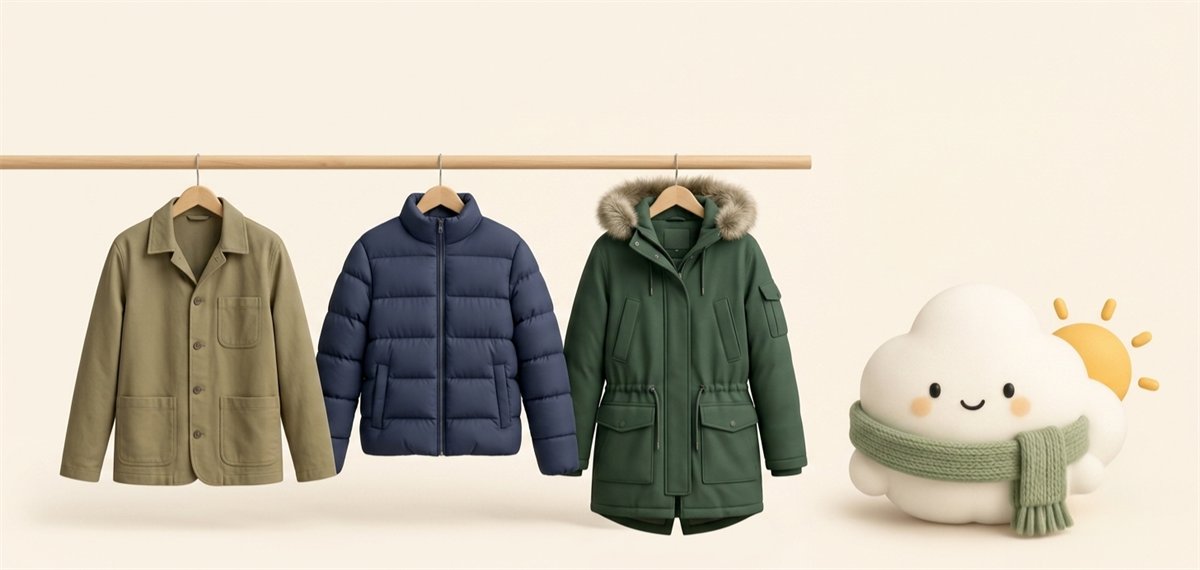
For a jacket, the feels-like number matters more than usual
The temperature on your weather app's front screen is air measured in the shade, standing still. You are none of those things.
Wind pulls heat off your skin. Humidity stops your sweat from cooling you. Sun on your shoulders adds a few degrees back. Forecasters fold all of it into one number, apparent temperature, which most apps label "feels like." That number has a lot going on under it, and this is the guide to reading it.
Here's why that number counts double for this particular decision. Wind is the biggest gap between the thermometer and your skin, and blocking wind is a large part of what a jacket does. So the reading that tells you whether you need a jacket is measuring the exact thing the jacket fixes. A hoodie decision can survive a bad guess about wind. A jacket decision usually can't.
What wind does to this: 45°F (7°C) with a 20 mph wind has a wind chill near 37°F (3°C). On the thermometer that's a light jacket day. On your skin it's a puffer day. One breeze moved you a full band down, and the jacket you'd have grabbed from the front-screen number would have been the wrong one.
Jacket weather by feels-like temperature
These are the bands Comfie's outfit engine runs on, in both scales. They come from how much warmth each layer adds, which is also why the handoffs sit where they do.
| Feels like | Jacket? | What we'd put on |
|---|---|---|
| 68°F and up20°C and up | No | T-shirt. A jacket here is luggage. |
| 62 to 68°F17 to 20°C | Only for the evening | Long sleeve by day. Take the jacket if you're out past sunset. |
| 52 to 62°F11 to 17°C | Yes, a light one | Light jacket over a long sleeve. A hoodie instead is the same warmth. |
| 48 to 52°F9 to 11°C | Yes, and it needs help | Fleece under the jacket. The jacket over one shirt runs short here. |
| 40 to 48°F4 to 9°C | Yes, over a hoodie | Long sleeve, hoodie, and a puffer vest on a calm dry day or a light jacket if it's windy or wet. Boots under 42°F (6°C). |
| 30 to 40°F-1 to 4°C | Light jacket is done. Puffer. | Long sleeve, fleece, puffer, beanie. Gloves under 35°F (2°C). |
| 20 to 30°F-7 to -1°C | Parka | Sweater under a parka, boots, beanie, gloves, scarf, wool socks. |
| Under 20°FUnder -7°C | Parka over everything | Thermal layer, sweater, parka, insulated pants, winter boots, wool socks. Thermal bottoms under 15°F (-9°C), a face covering at 10°F (-12°C). |
Swipe the table sideways for the rest of each row.
Don't want to do this every morning? The live demo runs these bands against real weather from your city name, no download.
Why a light jacket stops being enough at 48°F
Comfie's engine doesn't think in outfits. It thinks in warmth points, then picks clothes that add up to a target.
Every layer carries a number. A t-shirt is 2. A long sleeve, a hoodie, a fleece and a sweater are all 3. A light jacket is 2, and so is a puffer vest. A puffer is 4. A parka is 5.
That sounds fussy until you watch it settle an argument.
At a feels-like 55°F (13°C) the engine wants 5 points on your top half. A t-shirt plus a hoodie is 2 plus 3, which is 5. A long sleeve plus a light jacket is 3 plus 2, which is also 5. Identical. So the question people ask at this temperature, whether it's hoodie weather or jacket weather, has no answer, because it's both and they're the same amount of warm. Wear whichever one you like more.
Now drop to 50°F (10°C). The target moves to 6, and a long sleeve plus a light jacket is still 5. One point short.
You can feel that point. It shows up in the most common complaint about this exact temperature, which is some version of "I had a jacket on and I was still cold." The instinct is to blame the jacket and want a bigger one. The engine says the jacket is fine and the layer under it is wrong. Put a fleece in there instead of a shirt and you jump from 5 to 8, which overshoots comfortably. Or skip the jacket and wear a long sleeve under a fleece, which is exactly 6 and is what the engine actually picks if you let it.
So 48°F (9°C) is the real line. Above it, a light jacket over one shirt is a finished outfit. Below it, the jacket is the top of a stack and not the answer by itself.
Where the puffer takes over
40°F (4°C), and the reason is arithmetic rather than taste.
Under 40°F the engine wants 10 points up top. Stack your warmest realistic light-jacket outfit and count it: long sleeve 3, fleece 3, light jacket 2. That's 8. You're two short with nothing sensible left to add, because a second fleece under a slim jacket isn't happening.
Swap the light jacket for a puffer and its 4 points close the gap exactly. 3 plus 3 plus 4 is 10.
That's the whole handoff, and it's worth saying plainly: a puffer isn't vaguely warmer than a light jacket. It's worth two more points, and 40°F is the temperature where you need precisely two more points. Ten degrees later the parka does the same trick again, adding 5 where the puffer added 4, which is what gets you to the 11 points the engine wants below 30°F (-1°C).
Two things change under the jacket at the same time, and both are easy to forget. Boots replace sneakers under 42°F (6°C). The beanie comes out under 40°F (4°C), which is not a coincidence, because a bare head is a real fraction of the heat you lose.
Below that handoff you're out of jacket territory entirely, and it's a decision with its own rules. If what you're really asking is do I need a coat today, that guide picks it up from here: why the line lands on 39°F (4°C) rather than the 50°F everyone quotes, and what to wear through the 40s when a coat is still too much.
Why a hoodie stops replacing a jacket at 52°F
Down to 52°F (11°C) it's a genuinely even swap, and the points above show why. Below that it isn't, and the reason has nothing to do with warmth.
Cotton doesn't block wind. A hoodie at 45°F (7°C) with any breeze at all is just fabric that air moves through, which means the wind chill hits you at close to full strength. A light jacket with a woven shell stops that air, and stopping the air is most of what you paid for. Same story with water: a hoodie soaks and then holds cold water against you for hours.
This is the other side of a line we drew from the opposite direction in do I need a hoodie today, where a hoodie is a mid layer wearing a jacket's costume below 52°F. Above 52°F, wear the hoodie and don't think about it. Below 52°F, the hoodie moves underneath and something with a shell goes over the top.
The jacket you need at 8am and resent at 3pm
Autumn is when this question gets asked most, and it's also the season that makes it hardest. September through November runs the biggest daily swings of the year in most places: cold, clear mornings and afternoons that climb 20°F (11°C) or more by 3pm.
A hoodie shrugs that off. It ties around your waist and you forget it exists.
A jacket doesn't have that escape hatch. Once it's off you're carrying it, over an arm, through a shop, onto the back of a chair you'll walk away from. Which is why the honest advice for a big-swing day isn't about temperature at all.
Check both feels-like numbers, the low and the high. If they're within about 15°F (8°C) of each other, dress for the middle and you'll be fine all day. If the spread is bigger than that, you have to actually choose: take a jacket you don't mind carrying, or wear a hoodie or fleece as the outer layer and accept a chilly first twenty minutes.
I default to the second one on any day whose low is above 48°F (9°C). Twenty minutes of slightly cold beats eight hours of holding a coat.
If there's rain in the forecast
Most light jackets are not waterproof, and a lot of people find that out in the first ten minutes of a shower. Water-resistant buys you a short walk to the car. It doesn't buy you a commute.
A puffer is worse than that, because wet down clumps and stops insulating, so a soaked puffer is both heavy and colder than the jacket you didn't bring.
If real rain is coming, the outer layer needs to be a shell, or you need an umbrella over whatever you've got on. Comfie hedges toward the umbrella: once the chance of rain passes 50% at any point in the day, it goes in the outfit, because carrying a dry umbrella costs you nothing and getting soaked costs you the afternoon.
It makes two exceptions to that. Past about 20 mph an umbrella is a liability rather than a help, so on a wet and windy day it drops the umbrella and puts a rain jacket on you instead. And a day that stays wet for four hours or more swaps your sneakers for rain boots, because sneakers soak through when it never lets up.
Quick answers
Is 60 degrees jacket weather?
Yes, for a light one. 60°F (16°C) sits inside the light jacket band, and a jacket over a long sleeve is right for the whole day. If it's sunny and still, you'll probably carry it by noon. If there's wind, you'll keep it on.
Do I need a jacket at 65 degrees?
Not during the day. At 65°F (18°C) a long sleeve is enough on its own. The reason to take one anyway is the evening, because most places drop 10 to 15°F (6 to 8°C) after sunset, which lands you in jacket weather by the time you're heading home.
Is 50 degrees cold enough for a jacket?
Yes, and 50°F (10°C) is just past the point where the jacket needs help. A light jacket over one shirt comes up short here. Put a fleece or a hoodie underneath and you're set for the day.
What temperature is too warm for a jacket?
Above 68°F (20°C) you're carrying it, not wearing it. Between 62 and 68°F (17 and 20°C) it's an evening-only call. Over 68°F (20°C) a long sleeve or a t-shirt does the whole job.
Can I wear a hoodie instead of a jacket?
Down to about 52°F (11°C), yes, and the swap is close to exact. A hoodie over a t-shirt and a light jacket over a long sleeve add the same amount of warmth. Below 52°F (11°C) the hoodie loses, because it has no wind resistance and that's most of what a jacket is doing for you.
So, do you need a jacket today?
Three numbers, about fifteen seconds:
- Today's feels-like low. Under 62°F (17°C), take a jacket. Under 48°F (9°C), put a fleece or hoodie under it. Under 40°F (4°C), make it the puffer.
- Today's feels-like high. If it's more than 15°F (8°C) above the low, decide now whether you're willing to carry the thing. If you're not, wear a hoodie or fleece as your outer layer instead.
- Rain chance. Over 50%, your outer layer needs a shell or you need an umbrella. A light jacket won't cover it and a puffer will make it worse.
If the low is above 62°F (17°C) and the sky is behaving, leave it at home. That's the answer people are usually hoping for anyway.
Let Comfie do the checking
The live demo on the homepage runs these exact bands against real weather. Type your city and you'll see the outfit for right now, jacket or not, no download needed.
The iPhone app goes further. It asks whether you run hot or cold, then learns from your ratings, so a 55°F (13°C) day dresses differently for you than for someone who's always warm. Free, no ads.

Where these numbers come from: they're the warmth values and bands inside Comfie's own outfit engine, the same code that powers the app and the demo on this site. Weather data comes from Open-Meteo. Wind chill figures use the US National Weather Service formula. Temperatures here are feels-like, not raw air temperature, and the Celsius figures are rounded to the nearest degree.