 Comfie
Do I need a coat today?
Take a coat if the feels-like temperature is under 40°F (4°C). Between 40 and 48°F (4 and 9°C) a hoodie with a vest over it does the same job for less bulk. Under 30°F (-1°C) the puffer hands off to a parka.
Almost every guide answers this with "below 50°F" and stops there. That number is too warm by about ten degrees, and you can feel the error on a 45°F (7°C) morning, standing in the doorway with a coat you're going to be carrying by ten.
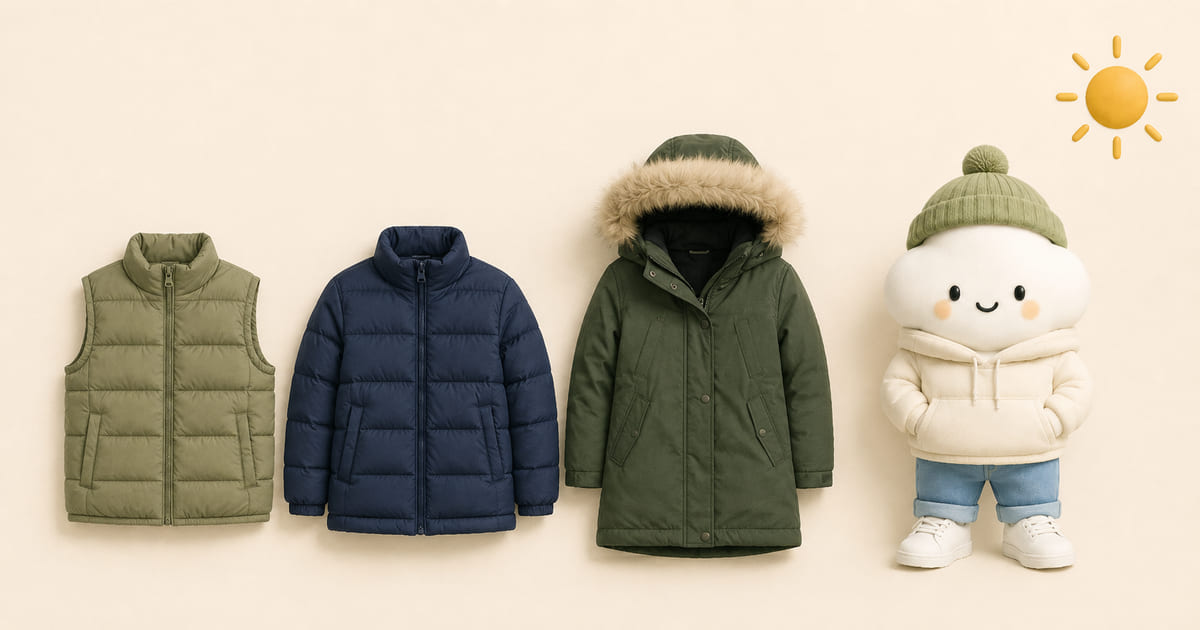
At what temperature do you need a coat?
A coat starts at a feels-like 39°F (4°C). At 40°F and above, a hoodie with a puffer vest over it is enough. One degree lower, the warmth target jumps from 8 points to 10, and a puffer coat is the only single layer that closes that gap.
That's a one-degree switch, which sounds absurd until you see what's underneath it.
Coat or jacket? The line is 39°F, not 50°F
Search this question and you'll get a dozen pages explaining that a coat is longer than a jacket, heavier than a jacket, more formal than a jacket. All true. None of it helps at 7am, because your hallway doesn't contain a hem-length problem. It contains a temperature.
Comfie's engine doesn't think about formality. It scores every layer with a warmth number and picks a stack that hits a target. A t-shirt is 2. A long sleeve, a hoodie, a fleece and a sweater are each 3. A light jacket is 2, and so is a puffer vest. A puffer coat is 4. A parka is 5.
Now run the two temperatures side by side.
At 44°F (7°C) the target is 8 points. Long sleeve 3, hoodie 3, puffer vest 2. Exactly 8, and you're done.
At 39°F (4°C) the target is 10. Take that same stack down with you and it's still 8. You're two short, and there's nothing sensible left to add, because nobody is putting a second hoodie under a fitted vest. Swap the vest for a puffer coat and its 4 points land you on 10 precisely.
So the difference between a coat and a jacket isn't warmth in some vague sense. It's two points, and 39°F is the temperature where you need exactly two more than a jacket can give you. Above that line the coat is overkill you'll resent by noon. Below it, no amount of layering under a light jacket gets you there.
Coat weather by feels-like temperature
These are the bands the engine runs on, in both scales. The handoffs sit where they do because of the point math above, not because 40 and 30 are round numbers.
| Feels like | Coat? | What goes on top |
|---|---|---|
| 52°F and up11°C and up | No | A hoodie is the outer layer. Nothing over it. |
| 48 to 52°F9 to 11°C | No | Fleece or hoodie on its own, over a long sleeve. |
| 40 to 48°F4 to 9°C | Not yet | Hoodie with a puffer vest over it on a calm dry day, a light jacket if it's windy or wet. Boots under 42°F (6°C). |
| 30 to 40°F-1 to 4°C | Yes, a puffer | Puffer coat over a fleece, plus a beanie. Gloves under 35°F (2°C). |
| 20 to 30°F-7 to -1°C | Yes, a parka | Parka over a sweater, boots, beanie, gloves, scarf, wool socks. |
| Under 20°FUnder -7°C | Parka over everything | Thermal layer, sweater, parka, insulated pants, winter boots. Thermal bottoms under 15°F (-9°C). |
Swipe the table sideways for the rest of each row.
Don't want to do this every morning? The live page runs these bands against real weather from your city name, no download.
The 40s are the hard part, and a vest fixes them
The 40 to 48°F (4 to 9°C) window is where people get this wrong in both directions on the same week. Monday you bring the coat and spend lunch holding it. Wednesday you skip it and spend the walk home regretting that.
What the engine picks here on a calm dry day is a puffer vest over a hoodie, which is an answer almost nobody gives.
The logic is worth following, because it changes how you think about the whole band. A vest is worth 2 points, identical to a light jacket. So you give up no warmth at all by choosing it. What you gain is that your arms stay out of it, and your arms are the first thing to overheat once you're walking, carrying a bag, or climbing stairs out of a station. The vest puts the insulation on the part of you that's actually cold and leaves the rest alone.
There are two conditions on this, and the engine enforces both. Wind at 20 mph (32 km/h) or more and the vest goes back to a light jacket, because a sleeveless layer has nothing to stop air moving over your arms. Any real chance of rain does the same thing, and if it's windy and raining you get a proper shell instead. On a still, dry, grey 44°F (7°C) day, though, the vest is the better piece and it isn't close. Right at the bottom of the band, far less wind than that matters: what to wear in 40 degree weather shows a 3 mph breeze tipping 40°F into coat weather.
This is the other side of a boundary we drew in do I need a jacket today, where a light jacket runs out of road below 48°F (9°C). Same stretch of thermometer, opposite question. If a jacket is what you're actually deciding about, that post is the one you want. This one starts where the jacket stops being enough. And if your 40s are really a breezy 50°F, what to wear in 50 degree weather shows how a 10 mph wind is enough to put you in this vest.
Boots and a beanie land on the same morning
Outerwear gets treated as one isolated decision, and it isn't. Three other things switch on within a few degrees of the coat, and forgetting them is why a coat sometimes still doesn't feel like enough.
Boots replace sneakers under 42°F (6°C), a degree or two before the coat. The beanie arrives under 40°F (4°C), which is the same threshold as the coat itself. Gloves come in under 35°F (2°C).
The beanie is the one to pay attention to, because it's the cheapest warmth on the list. It costs you nothing to carry, it goes in a pocket when the sun comes out, and it covers ground no coat reaches. If you've ever worn a heavy coat and still felt cold at a bus stop, this is usually the reason, and the fix is not a bigger coat.
When the parka takes over
30°F (-1°C), and it's the same trick as before. The target moves from 10 points to 11. A parka is worth 5 where the puffer was worth 4, and the mid layer steps up from a fleece to a sweater at the same time. Plenty of mornings cross that line without the thermometer moving, because a light breeze is enough. What to wear in 30 degree weather has the numbers.
Below 30°F the accessories stop being optional. A scarf and wool socks join the beanie and gloves, and the engine returns all of them together rather than ramping them in one at a time, because at that temperature the gaps matter more than the coat does.
Under 20°F (-7°C) it changes character again. A thermal layer goes on first, insulated pants replace jeans, and winter boots replace boots. That's the deep freeze, and it's a different post.
Quick answers
What is the difference between a coat and a jacket?
Two points of warmth, in the only sense that matters at 7am. Comfie's engine scores a light jacket at 2 and a puffer coat at 4, so the coat is worth one extra mid layer. Length and formality are how shops sort outerwear, and neither one is what the temperature responds to.
Is 40 degrees cold enough for a winter coat?
Not quite. At a feels-like 40°F (4°C) the engine wants 8 points on your top half, and a long sleeve, a hoodie and a puffer vest cover it. Drop one degree to 39°F and it wants 10, which is the first temperature where a coat is the right call rather than an overreaction.
Do I need a coat at 45 degrees?
No. 45°F (7°C) sits in the middle of the vest band. A hoodie over a long sleeve with a puffer vest on top is the whole outfit on a calm dry day, and a light jacket instead if there's wind or rain. Bring a coat here and you'll be carrying it by mid-morning.
Is a puffer vest warm enough instead of a coat?
Between 40 and 48°F (4 and 9°C), yes, and it's what the engine picks on a calm dry day. A vest and a light jacket are both worth 2 points, so the vest gives up nothing in warmth and leaves your arms free. Under 40°F (4°C) it runs short no matter what you put underneath.
Do I need a coat if it is sunny out?
Standing in direct sun feels warmer than the number, but that fades the moment you're in shade or moving, and a clear 38°F (3°C) morning is still coat weather. The forecast high matters more than the sunshine. If it climbs past 48°F (9°C), take the vest and skip the coat.
What temperature do you need gloves and a hat?
A beanie comes in under 40°F (4°C), the same point as the coat. Gloves follow under 35°F (2°C), then a scarf and wool socks under 30°F (-1°C). They get their own thresholds because a coat covers none of the places you lose heat fastest.
So, do you need a coat today?
Two numbers and about ten seconds:
- Today's feels-like low. Under 40°F (4°C), take the coat. Under 30°F (-1°C), make it the parka. Anywhere in the 40s, a hoodie with a vest or a light jacket over it is the better call.
- Today's feels-like high. If it climbs past 48°F (9°C) by afternoon, you're going to be carrying whatever you brought. That's the day to wear the vest and put the coat back.
And if the number sitting in front of you is 39, 40 or 41, you've found the one place where the answer genuinely flips on a single degree. Check the feels-like rather than the air temperature, because wind chill is what drags a 44°F morning into coat weather and it's the difference that decides this band.
Let Comfie do the checking
The live page runs these exact bands against real weather. Type your city and you'll see the outfit for right now, coat or not, no download needed.
The iPhone app goes further. It asks whether you run hot or cold, then learns from your ratings, so a 42°F (6°C) day dresses differently for you than for someone who's always warm. Free to download, no ads.

Where these numbers come from: they're the warmth values and bands inside Comfie's own outfit engine, the same code that powers the app and the demo on this site. Weather data comes from Open-Meteo. Wind chill figures use the US National Weather Service formula. Temperatures here are feels-like, not raw air temperature, and the Celsius figures are rounded to the nearest degree.