 Comfie
Is it jeans weather today?
Almost certainly yes. Jeans work from a feels-like 20 to 74°F (-7 to 23°C), which is a 55 degree window and the widest of anything in your wardrobe. Above 75°F (24°C) you want lighter pants. Above 80°F (27°C), shorts. Below 20°F, insulated ones.
Which makes this a strange question to build an article around, because the answer is nearly always yes and you probably suspected that already.
The interesting part is what that window does to the rest of the decision. Your legs are sorted for 55 degrees of weather. Your top half is not. It changes seven times across that same stretch, and every one of those changes is a morning where you can get it wrong.
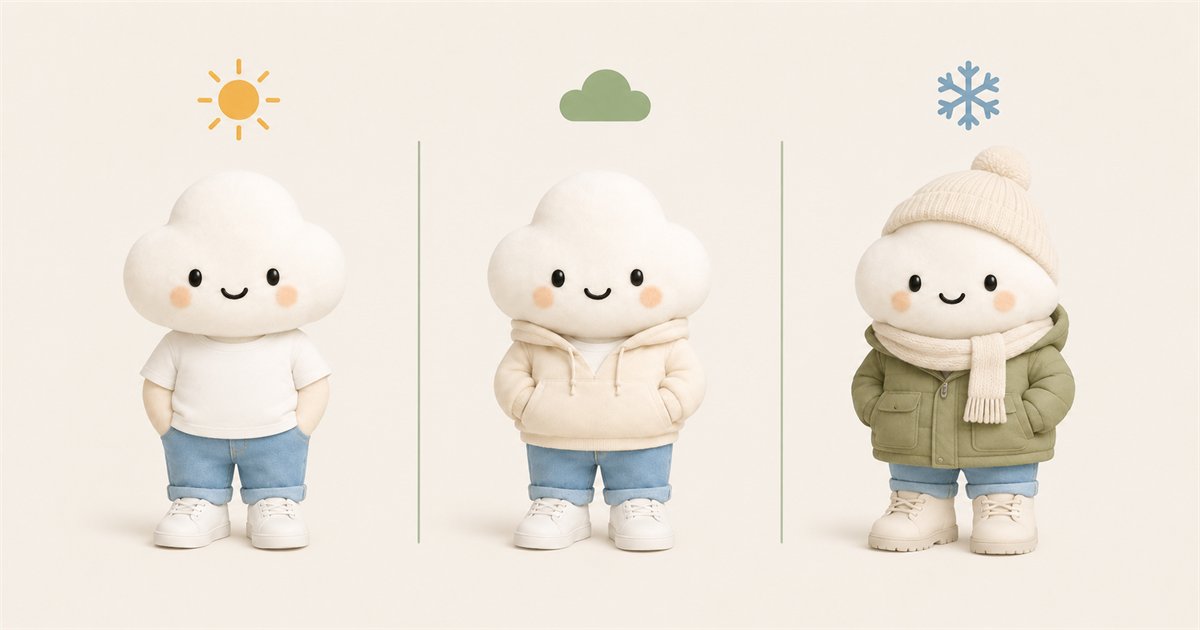
What temperature is jeans weather?
Jeans weather is a feels-like 20 to 74°F, or -7 to 23°C. Inside that band Comfie's engine puts you in jeans and spends its effort on everything above the waist. At 75°F it swaps to lighter pants. At 80°F, shorts. At 19°F, insulated pants.
Run the numbers against anything else you own and the gap is embarrassing. Shorts get about ten degrees before a tank top and sandals take over. A hoodie owns exactly ten, 52 to 62°F. A puffer vest gets eight. Jeans get 55.
Nothing else is close. Jeans aren't one option among several for a given day. They're the default, and the exceptions are narrow.
Where jeans start and stop
These are the cut points inside the engine. They sit where the temperature math puts them, not on round numbers.
| Feels like | On your legs | Why |
|---|---|---|
| 80°F and up27°C and up | Shorts | Denim has almost no airflow. Above this you're carrying insulation for no reason. |
| 75 to 80°F24 to 27°C | Lighter pants | The gap most people don't know exists. Too warm for denim, not warm enough for shorts. |
| 20 to 75°F-7 to 24°C | Jeans | Fifty-five degrees, unchanged. Everything that adapts to the weather happens above your waist. |
| 15 to 20°F-9 to -7°C | Insulated pants | Denim runs out. There's nothing left up top to compensate with. |
| Under 15°FUnder -9°C | Thermal base underneath | A thermal layer goes under the insulated pants rather than replacing them. |
Swipe the table sideways for the rest of each row.
Don't want to do this every morning? The live page runs these bands against real weather from your city name, no download.
75°F is where jeans come off, and it isn't shorts that replace them
At a feels-like 74°F (23°C) Comfie returns a t-shirt, jeans and sneakers. At 75°F (24°C) it returns a t-shirt, lighter pants and sneakers.
Not shorts. Pants.
Shorts don't arrive until 80°F (27°C), which leaves a five degree strip in the middle where the engine wants long trousers that aren't denim. Chinos, linen, whatever lightweight thing you own. It's the least intuitive cut point in the whole system and I've never seen another guide mention it.
The reason is that denim is doing two jobs and only one of them stops mattering. It covers your legs, and it insulates them. Around 75°F you still want the coverage and you've stopped wanting the insulation, so the answer is a lighter trouser rather than less trouser. By 80°F you've stopped wanting either, and that's where shorts begin.
Worth knowing if you've ever pulled on jeans at 77°F, felt wrong about it by mid-morning, and concluded you should have worn shorts. You shouldn't have. You were two garments away from right, not one.
The part that actually changes is your top half
Here's the whole argument in one table. Feels-like temperature down the left, what Comfie returns on the right, jeans in the middle refusing to move.
| Feels like | Legs | Everything else |
|---|---|---|
| 68 to 75°F20 to 24°C | Jeans | T-shirt, sneakers |
| 62 to 68°F17 to 20°C | Jeans | Long sleeve, sneakers |
| 52 to 62°F11 to 17°C | Jeans | T-shirt, hoodie, sneakers |
| 48 to 52°F9 to 11°C | Jeans | Long sleeve, fleece, sneakers |
| 40 to 48°F4 to 9°C | Jeans | Long sleeve, hoodie, puffer vest. Boots from 40°F down. |
| 30 to 40°F-1 to 4°C | Jeans | Long sleeve, fleece, puffer coat, boots, beanie. Gloves from 32°F. |
| 20 to 30°F-7 to -1°C | Jeans | Long sleeve, sweater, parka, boots, beanie, gloves, scarf, wool socks |
Swipe the table sideways for the rest of each row.
Seven distinct outfits. One pair of jeans.
Read the middle column top to bottom and it's the same word every time, which is the point. Every guide that tells you to consider your jeans carefully has the question backwards. The jeans are the settled part. The bit worth thinking about at 7am is whether today is a long sleeve day or a hoodie day, and those two are separated by six degrees.
If you want that one in detail, the 52 to 62°F band is where a hoodie over a tee stops being optional and starts being the answer.
19°F is where denim finally gives up
At a feels-like 20°F (-7°C) you're in jeans, a sweater, a parka, boots, a beanie, gloves, a scarf and wool socks. Eight things. Still jeans.
One degree lower and the engine swaps them for insulated pants.
That's a stubborn floor, and it's deliberate. Denim insulates poorly for how heavy it is, so it isn't keeping you warm at 25°F either. What's keeping you warm is the parka. Jeans survive down to 20°F because your top half is doing all the work and they're not making things worse.
At 19°F the top half runs out of room. There's nothing above a parka in Comfie's catalogue, so the only place left to add warmth is your legs, and that's the moment jeans get replaced rather than supplemented. Below 15°F (-9°C) a thermal base goes on underneath the insulated pants too, which is the one place in the whole system where two bottom layers stack.
Practical version: if you're cold in jeans at 30°F, the fix is a better coat, not different trousers. The engine agrees with you right up until 19°F. The rest of a 30°F outfit is in what to wear in 30 degree weather.
Humidity doesn't need its own rule
Search this question and you'll find people splitting the answer in two. 85°F if it's dry, 78°F if it's humid. One forum thread works it out to the degree.
All of that effort is already done for you.
Comfie reads the feels-like temperature, and humidity is baked into that number before the engine sees it, along with wind chill. So on a muggy day the feels-like reading climbs past 75°F on its own and jeans drop out without you adjusting anything. The single 75°F line is the humid answer and the dry answer at the same time.
This is also why reading the wrong number breaks the whole thing. A dry 78°F day and a humid 78°F day are different decisions if you're looking at the thermometer, and the same decision if you're looking at the feels-like. Use the second one.
Wind is the exception that proves it. Between 52 and 74°F (11 and 23°C), a genuinely windy day adds a windbreaker on top. The jeans don't change. Wind gets you above the waist or not at all.
Quick answers
Is it jeans weather today?
Almost certainly yes. If today's feels-like temperature is anywhere between 20 and 74°F (-7 and 23°C), jeans are the right bottom half. That covers most days in most places. The only two ways out are a feels-like of 75°F (24°C) or higher, where lighter pants win, and 19°F (-7°C) or lower, where insulated pants take over.
Can you wear jeans in 80 degree weather?
You can, but Comfie won't suggest it. At a feels-like 80°F (27°C) the engine returns shorts, and it stopped returning jeans five degrees earlier at 75°F (24°C). Denim is a heavy, tightly woven fabric with almost no airflow, so at 80°F you're carrying insulation you don't need. If you want to stay in long trousers, lighter pants are the swap.
How cold is too cold for jeans?
19°F (-7°C). Down to 20°F Comfie keeps jeans on and adds layers above the waist instead. At 19°F it swaps them for insulated pants, because denim has no meaningful insulation of its own and there's nothing left on your top half to compensate with. Below 15°F (-9°C) a thermal base goes on underneath as well.
Are jeans OK in humid weather?
The 75°F ceiling already accounts for it. Comfie reads the feels-like temperature, and humidity is built into that number before the engine ever sees it. So on a sticky day the feels-like reading climbs past 75°F on its own and jeans drop out without you doing any mental arithmetic. You don't need a separate humid-weather rule.
What should I wear on top with jeans?
It depends entirely on the temperature, and this is the part that actually changes. A t-shirt from 68 to 74°F (20 to 23°C), a long sleeve from 62 to 68°F (17 to 20°C), a hoodie over a t-shirt from 52 to 62°F (11 to 17°C), a fleece from 48 to 52°F (9 to 11°C), a puffer vest from 40 to 48°F (4 to 9°C), a puffer coat from 30 to 40°F (-1 to 4°C), and a parka below that.
So, is today a jeans day?
Check one number and you're done. Today's feels-like temperature:
- Between 20 and 74°F (-7 and 23°C). Yes. Put the jeans on and spend your thinking on the top half instead, because that's the decision with actual stakes.
- 75°F or higher (24°C). No. Lighter pants up to 80°F (27°C), shorts above it.
- 19°F or lower (-7°C). No. Insulated pants, with a thermal base under them below 15°F (-9°C).
On a day that starts at 45°F and finishes at 72°F, notice that both ends of that swing are inside the window. The jeans are right for the entire day. It's the three layers above them that need a plan for the afternoon, and that's true of most days that feel like they need a plan at all.
Let Comfie do the checking
The live page runs these exact bands against real weather. Type your city and you'll see the outfit for right now, top half included, no download needed.
The iPhone app goes further. It asks whether you run hot or cold, then learns from your ratings, so a 74°F (23°C) day sits inside the window for you and outside it for someone who runs warm. Free to download, no ads.

Where these numbers come from: they're the cut points inside Comfie's own outfit engine, the same code that powers the app and the demo on this site. Weather data comes from Open-Meteo. Wind chill figures use the US National Weather Service formula. Temperatures here are feels-like, not raw air temperature, and the Celsius figures are rounded to the nearest degree.