 Comfie
What temperature is shorts weather?
Shorts weather starts when it feels like 80°F (27°C). Below that, Comfie puts you in lighter pants down to 75°F (24°C) and in jeans below that. Most people reach for shorts around 68°F, which is roughly twelve degrees early, and we picked the warmer number on purpose.
That's an unpopular answer. When YouGov asked people for the lowest temperature they'd wear shorts outdoors, the most common bracket was 61 to 70°F, taking 25% of the vote. A WCCO poll in March 2020 had 61% of Minnesotans saying 60°F was warm enough. So the crowd says high 60s, and we say 80.
Here's the reasoning, which comes down to one thing that has nothing to do with how warm your legs feel.
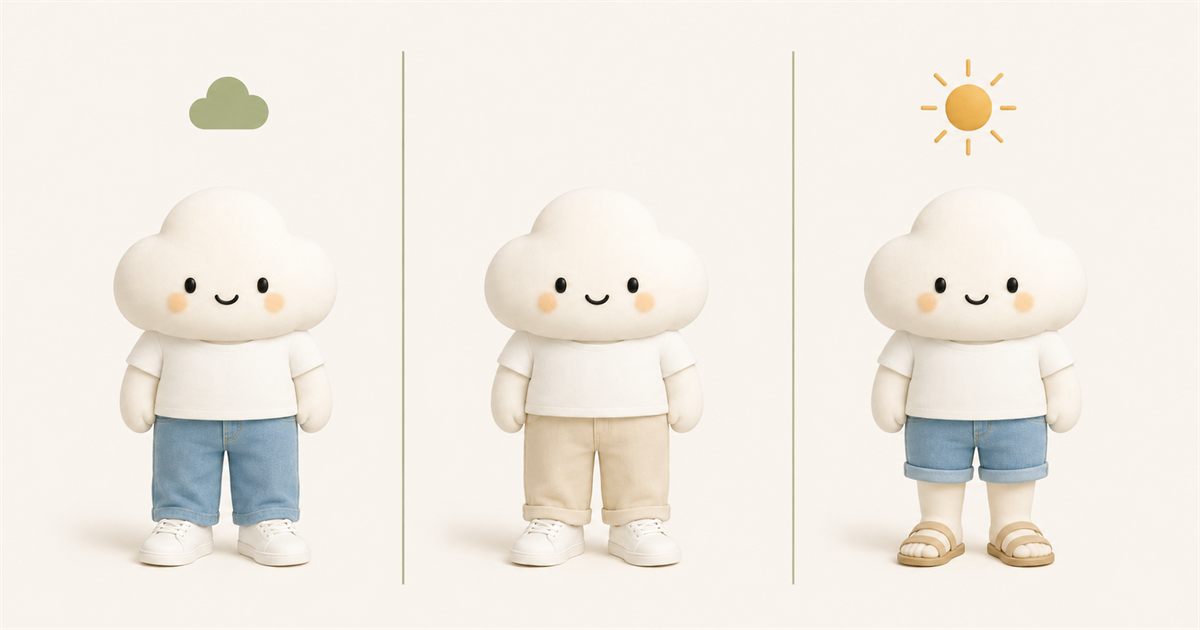
Shorts or pants, by feels-like temperature
These are the actual thresholds inside Comfie's outfit engine, the same code behind the demo on this site. Every number below is read out of the engine rather than estimated.
| Feels like | Shorts? | What Comfie puts on |
|---|---|---|
| 85°F and up29°C and up | Yes, and sandals with them | Tank top, shorts, sandals. |
| 80 to 85°F27 to 29°C | Yes, this is where it starts | T-shirt, shorts, sneakers. |
| 75 to 80°F24 to 27°C | Not by default | T-shirt and lightweight pants. Shorts if you run hot, or if it's sunny and humid. |
| 68 to 75°F20 to 24°C | No | T-shirt and jeans. This is the band most people call shorts weather. |
| 62 to 68°F17 to 20°C | No | Long sleeve and jeans. |
| 52 to 62°F11 to 17°C | No | T-shirt, hoodie, jeans, sneakers. |
| Under 52°FUnder 11°C | No | Jeans hold the bottom half down to 20°F (-7°C), then insulated pants take over. |
Swipe the table sideways for the rest of each row.
Notice how little room lightweight pants get. Five degrees, between 75 and 80°F (24 and 27°C), and that's the entire handoff between covered legs and bare ones. Everything above is shorts. Everything below is jeans, for another 55 degrees, which is it jeans weather today takes from this line all the way down.
Why the line is 80°F and not 68°F
When we set this threshold, the audit of what other sources recommend landed on 78 to 80°F as the mainstream range. We took the warmer end of it. The tiebreaker wasn't a study about leg comfort. It was this:
A jacket is a decision you can revisit at 3pm. Trousers are a decision you make once, at breakfast, for the whole day.
That asymmetry is built into the app rather than just believed. Every bottom in the clothing catalog is flagged as not adjustable, alongside base shirts and shoes, and the day plan only ever suggests adding or shedding adjustable things. It will tell you the fleece comes off at 11am. It will never tell you to swap your legs at 2pm, because you'd have to go home to do it.
So the two ways of being wrong cost different amounts. Guess too light and you're in shorts on a 66°F evening with three hours to go and no recovery. Guess too heavy and your legs are warm. Warm legs is a mild complaint you can improve by finding shade or rolling something up. Cold legs is the rest of your evening.
When one direction has an escape hatch and the other doesn't, the default takes the safer side. That's the whole argument for 80 over 78, and it's why we didn't drift down toward the 68°F the crowd prefers.
The locked-in problem is bigger than shorts, and it has its own article: cold morning, warm afternoon works through the three things you can't take off at 2pm and what that does to a 25 degree swing.
Don't want to run this check every morning? The live demo does it from your city name, no download.
Sun and shade are two different days
Official air temperature is measured in the shade. Always has been, by definition, in a ventilated white box that keeps direct sun off the sensor. So the number on your screen has never described standing in a sunbeam.
Feels-like fixes part of that. Open-Meteo, which supplies Comfie's weather, defines apparent temperature as the perceived feels-like temperature combining wind chill factor, relative humidity and solar radiation. Sunshine is genuinely in there.
The catch is what it assumes about you. The radiation term is calculated for someone out in the open, so the number is the sunny-side estimate, and the forecast has no idea you'll spend the day on the north side of the street. The US National Weather Service puts full sunshine at up to 15°F (8°C) above the shaded figure. That gap is bigger than the entire pants band.
Practically: a cloudless 78°F (26°C) on an open patio is a shorts day and the engine is being conservative. The same 78°F walking a shaded city street, in and out of air conditioning, is not. Same forecast, different afternoon. We pulled the mechanics apart in feels like vs actual temperature.
Humidity moves the line, and one app rule stays out of its way
Muggy air raises apparent temperature, so a humid 76°F (24°C) can read past 80°F and hand you shorts while the thermometer still says something reasonable. That's working as intended, because humidity is exactly what makes bare legs worth having.
Here's the mechanism, which is worth thirty seconds. Your legs cool by evaporating sweat. Humid air is already close to full, so the sweat sits there instead of leaving, and you keep the heat. Shorts help most when the air is dry enough to take the moisture. In genuinely soupy conditions, loose lightweight trousers can beat tight shorts, which surprises people every summer.
There's a related rule inside the app that most users will never see. Comfie applies a damp-day correction that treats cool humid days as slightly colder, capped at 2°F, and it switches off completely at 70°F. That ceiling is deliberate. Above 70°F, humidity is already inside the apparent temperature, so a second correction would count the same air twice and drag the shorts line around for no reason.
One more wrinkle, and it's the reason a lot of weather apps are useless for this specific question. The US heat index isn't reported below about 80°F, and wind chill stops at 50°F. Apps built on those two formulas have nothing to say in between, so they show you the plain air temperature and label it feels-like. The shorts decision lives at 68 to 80°F, right in the middle of that dead zone.
The evening is what actually catches people
A day that peaks at 82°F (28°C) at four in the afternoon can be 65°F (18°C) by nine in the evening. Nothing unusual about that. Clear skies and dry air make it more likely, not less, because the same conditions that let the sun cook you all afternoon let the heat escape after sunset.
Your top half shrugs at this. Take the layer off, put the layer on, done.
Your legs made their choice at breakfast.
So for the bottom half, the number worth checking isn't the afternoon high at all. It's the feels-like temperature for the last hour you'll still be outside. If you're home by five, use the high. If there's a patio dinner in the plan, that 65°F is the number your legs will be living with, and shorts stop being obviously right.
The hoodie and jeans post frames this as dressing your top for the low and your bottom for the high. Shorts are where that rule shows its other half: the committed layer has to survive both ends of the day, so it's the whole arc that decides, not the peak.
If you're a shorts person, the line moves for you
Everything above describes the default, and the default is deliberately built for someone we know nothing about. The app does know something about you.
Answer the runs-hot-or-cold question and you get a 4°F (2°C) offset immediately. After that, rating your outfits moves it up to another 6°F (3°C), learned separately for cold, mild and hot days. Ten degrees is the ceiling in either direction, which means a committed shorts person hits the shorts band when the thermometer reads 70°F, while someone who runs cold won't see shorts until 90°F.
That 70°F is a hard floor, by the way. There is no profile, no rating history and no weather combination that gets Comfie to recommend shorts below a feels-like 70°F. The personalization can only shift the same line, not remove it.
For what it's worth, I'd put shorts on at 70°F myself. But pants are also completely fine at 70°F, and that's the point: at 70 both answers work and only one of them can strand you. At 80 and up it's a shorts day for anybody, which is what makes it the right place for a default to sit.
The opposite case, people who simply don't wear shorts in any weather, was deliberately not solved by lowering the threshold or adding another profile question. It's handled by wardrobe exclusions instead, where you switch the item off and the engine builds around it. Moving everyone's default to accommodate one group is how you end up with a number that fits nobody. More on how the personal offset is learned in why am I always cold.
Quick answers
Is 70 degrees warm enough for shorts?
It's warm enough to get away with, not warm enough to be the default. At a feels-like 70°F (21°C) Comfie puts you in a t-shirt and jeans. Shorts are pleasant in the sun at that temperature and cold the moment it drops, and since you can't change your legs at 6pm, the default stays covered.
Is 65 degrees too cold for shorts?
For most people, yes, and specifically once they stop moving. 65°F (18°C) is fine while you're walking and cold within ten minutes of sitting down outside. Comfie won't suggest shorts at 65°F for anyone, whatever their profile says.
Should I wear shorts or pants at 75 degrees?
Pants, but it's close. 75°F (24°C) is exactly where Comfie swaps jeans for lighter pants, and shorts are still five degrees off. Strong sun and high humidity both push the real feeling upward, so a muggy cloudless 75°F day is the one version of this where shorts win.
What temperature is too cold for shorts?
Below a feels-like 70°F (21°C) there's no version of the forecast where Comfie recommends them, because 70°F is as low as the line goes even for someone who runs hot. Under 60°F (16°C) you're wearing shorts for reasons other than comfort, which is a fine thing to do, just not a weather decision.
Do shorts actually keep you cooler than pants?
In dry heat, yes. Bare legs cool by evaporating sweat, so shorts do their best work when the air is dry enough to take that moisture. In muggy air the evaporation stalls and loose lightweight trousers can beat tight shorts, which is why the shorts question above 75°F (24°C) is really a humidity question.
So, is today a shorts day?
Three numbers, about fifteen seconds:
- Today's feels-like high. 80°F (27°C) or more and shorts are the call. 75 to 80°F (24 to 27°C) means lightweight pants. Under 75°F, jeans.
- The feels-like temperature when you're heading home. If that's in the 60s, your legs will notice, and they can't do anything about it by then.
- Sun and humidity. Cloudless, humid and mostly outdoors pushes you toward the earlier end of the range. Overcast, dry and in and out of buildings pushes you back.
If the high clears 80°F and you'll be home before the drop, stop thinking about it and wear the shorts. That's the easy version of this question, and it's most of summer.
Let Comfie do the checking
The live demo on the homepage runs these exact bands against real weather. Type your city and you'll see the outfit for right now, shorts or not, no download needed.
The iPhone app goes one step further. It asks whether you run hot or cold, then learns from your ratings, so a 76°F (24°C) day dresses differently for you than it does for someone who's always cold. Free, no ads.

Where these numbers come from: they're the warmth bands inside Comfie's own outfit engine, the same code that powers the app and the demo on this site. Weather data comes from Open-Meteo. Temperatures here are feels-like, not raw air temperature, and the Celsius figures are rounded to the nearest degree. Survey figures are from YouGov and a March 2020 WCCO poll.